
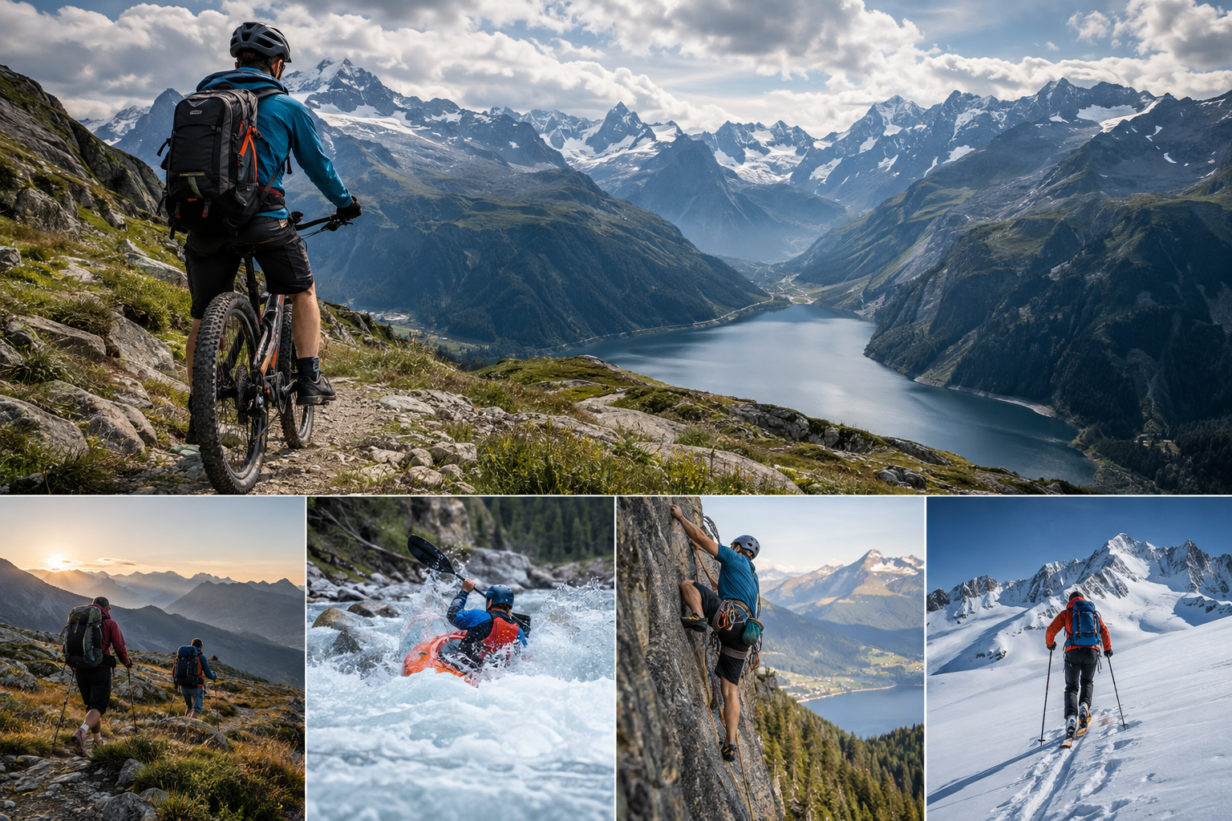
Let’s talk about outdoor & adventure fitness. Many years ago, I travelled to Swiss Alps for touring around by bike.
However, very first from Stockholm to Zurich by train. I was a bit unlucky because my almost new MTB was stolen right in Stockholm. I sent it by train – needed to use different train than mine.
What happened? My bike never arrived in Zurich. That time mountain bikes were rather new thing, and maybe someone liked it and wanted to socialize to own use.
Anyway, I rented bike in Switzerland and started my adventure. I don’t know how much I was planning or even thinking different scenarios. Maybe my idea was something like let’s take what it gives.
Years have passed since those days. Later I’ve been hiking in Switzerland, Italy and Austria. Nothing extreme but more like enjoying mountains and scenery.
Now we can take a bit different approach and talk more about different aspects of outdoor and adventure fitness.
Adventure fitness sits at the intersection of physical conditioning, psychology, technical competence, environmental awareness, risk management, and decision-making. Unlike ordinary gym-based exercise, adventure activities place the participant in an environment that is not completely controllable. Weather changes, terrain varies, equipment matters, fatigue affects judgment, and decisions can have genuine consequences.
I’ll write numbered topics to keep this more structured instead of just giving definitions. I have also added some activities that are not familiar to me by my own experience.
1. Types of adventure: difficulty, risks and skills required
An adventure activity normally contains some combination of uncertainty, challenge, exploration, perceived or actual risk, physical effort, and interaction with the natural environment.
Adventure does not automatically mean extreme sport. A five-hour hike through unfamiliar terrain can be an adventure even though it involves considerably less objective danger than alpine climbing.
A useful way to classify adventure
We can broadly divide outdoor adventure into land, mountain, water, air and multi-environment activities.
| Activity | Typical difficulty | Main risks | Important skills |
| Walking/hiking | Low–medium | Falls, weather, getting lost | Basic navigation, pacing |
| Trekking | Medium | Fatigue, weather, isolation | Navigation, endurance, planning |
| Trail running | Medium | Falls, ankle injuries, dehydration | Running fitness, terrain reading |
| Gravel cycling | Low–medium | Falls, traffic, mechanical failure | Bike handling, repair skills |
| Mountain biking | Medium–high | Crashes, fractures | Technical riding |
| Bikepacking | Medium | Fatigue, navigation, weather | Cycling, logistics, self-sufficiency |
| Kayaking | Medium | Capsizing, cold water | Paddling, rescue skills |
| White-water kayaking | High | Drowning, rocks, entrapment | Advanced paddling/rescue |
| SUP | Low–medium | Wind, cold water, drowning | Balance, paddling |
| Rock climbing | Medium–high | Falls, equipment errors | Belaying, climbing technique |
| Mountaineering | High | Falls, avalanche, altitude, weather | Navigation, rope work, alpine skills |
| Ski touring | High | Avalanche, exposure, falls | Skiing, avalanche knowledge |
| Caving | Medium–high | Falls, flooding, hypothermia | Navigation, rope skills |
| Paragliding | High | Weather, collision, hard landing | Flight and meteorological skills |
Difficulty is multidimensional
One of the first things I would teach an adventure student is:
Physical difficulty and danger are not the same thing.
Cycling 150 km might be extremely physically demanding but technically straightforward. Conversely, crossing a short, exposed mountain ridge might require little cardiovascular effort but carry serious consequences if you fall.
Therefore, assess at least:
Physical demand, technical difficulty. environmental exposure, remoteness, consequences of error.
You could think of overall challenge approximately as:
Adventure challenge = physical demand × technical demand × environmental complexity × exposure
It isn’t a mathematical formula, but it is a useful decision-making model.
Risk also changes dynamically
Consider hiking.
A 10 km marked trail near a town on a sunny summer afternoon may present relatively little risk. The same distance becomes very different when there is:
- snow
- darkness
- −10°C temperature
- strong wind
- poor visibility
- no phone coverage
- steep terrain
- an exhausted participant
This introduces an important adventure concept:
Objective versus subjective hazards
Objective hazards come primarily from the environment: weather, avalanche, rockfall, currents, temperature, terrain and altitude.
Subjective or human-factor hazards arise from participants: poor judgment, inadequate fitness, insufficient skills, fatigue, overconfidence, panic, bad equipment use and group pressure.
Very often accidents result from an interaction between the two.
2. High, medium and low accessibility of adventure sports
Here, accessibility means how easily an ordinary person can begin participating, considering cost, location, equipment, instruction, fitness and technical barriers.
It does not mean that an activity is automatically safe.
High accessibility
Activities requiring relatively little specialist equipment or training include:
- walking
- hiking
- Nordic walking
- recreational cycling
- basic gravel cycling
- easy trail running
- orienteering at beginner level
- recreational swimming
- beginner SUP
Someone can often begin these with relatively modest investment and basic instruction.
Medium accessibility
These usually require equipment, facilities, instruction or greater technical competence:
- mountain biking
- road cycling
- bikepacking
- kayaking
- canoeing
- indoor/outdoor climbing
- surfing
- cross-country skiing
- downhill skiing
- longer wilderness trekking
- open-water swimming
Low accessibility
The entry threshold becomes considerably higher:
- mountaineering
- alpine climbing
- ice climbing
- technical caving
- white-water kayaking
- ski mountaineering
- technical canyoning
- paragliding
- expedition diving
- high-altitude expeditions
- polar expeditions
The barriers may include specialist knowledge, expensive equipment, certification, experienced partners, geographical availability and substantial training.
Importantly, accessibility and risk again aren’t synonymous. Road cycling is highly accessible but riding in traffic introduces meaningful risk. Indoor climbing has a higher entry barrier but operates in a highly controlled environment.
3. Sports psychology: performance limits and injury
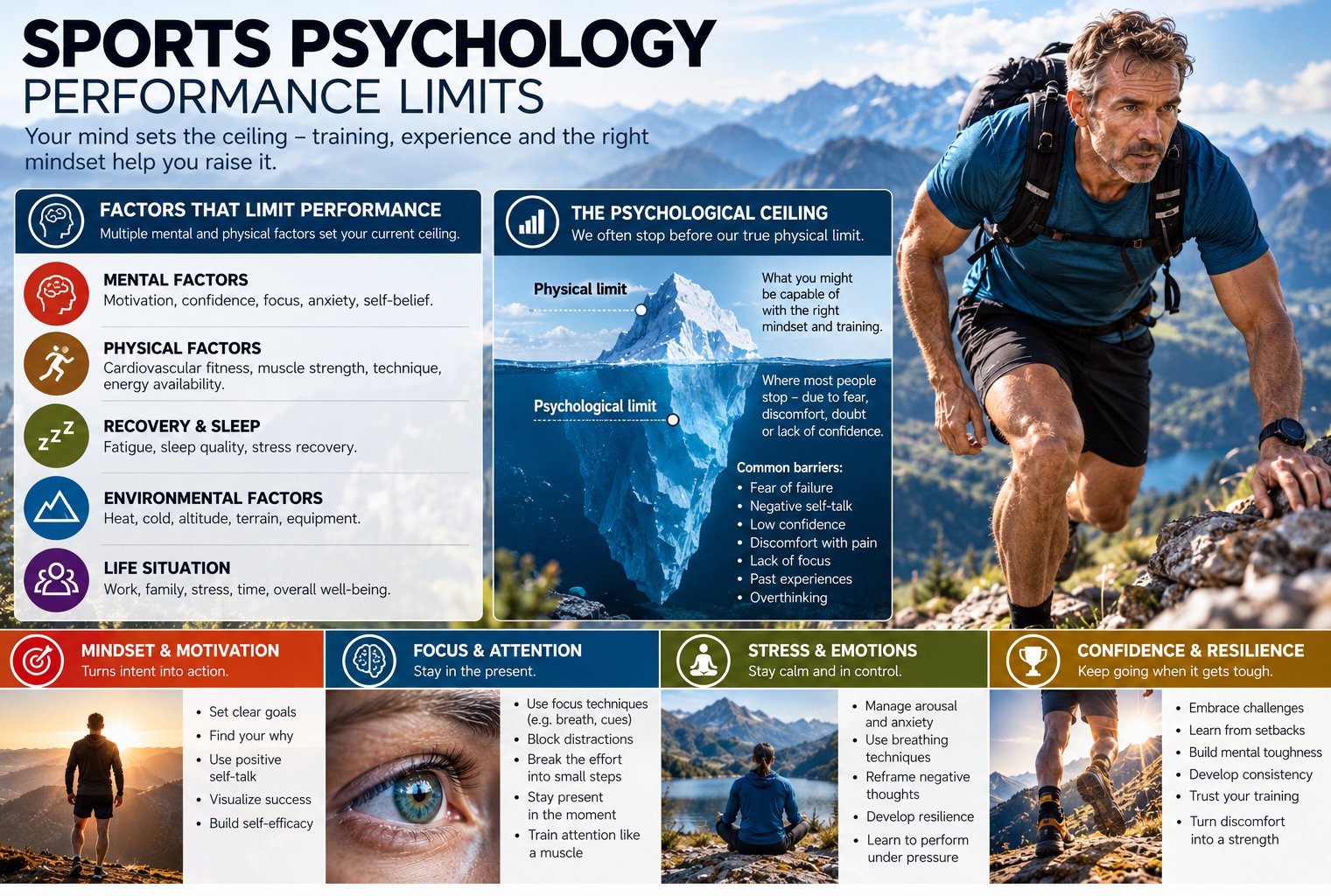
Sports psychology
Adventure sport provides an especially interesting laboratory for psychology because the athlete is simultaneously managing effort, uncertainty, fear and decision-making.
The psychological limits of performance
Imagine climbing a steep hill on a bicycle.
Your legs hurt.
Breathing becomes heavy.
Heart rate rises.
The brain begins producing a very persuasive message: “Slow down.”
This sensation doesn’t simply represent muscles reaching an absolute mechanical limit. Performance is influenced by an interaction between physiological signals and psychological interpretation.
Important factors include:
Motivation , how important completing the activity feels.
Self-confidence, whether you believe you possess the ability to succeed.
Perceived difficulty, how difficult the effort feels.
Distraction, psychological and physiological activation.
Attention, where you direct mental resources.
Fear and anxiety, particularly important in climbing, descending, technical cycling and exposed environments.
Previous experience, familiar situations generally require less cognitive processing.
Confidence, useful when grounded in competence, dangerous when it becomes overconfidence.
Distraction and performance
Too little arousal can produce poor concentration.
Moderate distraction may improve focus and performance.
Excessive distraction can impair fine motor control, perception and decision-making.
The optimal level depends strongly on the task.
A powerful sprint may tolerate high distraction.
Technical climbing requiring precise movements may benefit from greater psychological control.
Fear
Fear is not necessarily an enemy. In adventure sport, it can be a protective information system.
Fear may increase:
- attention
- physiological readiness
- environmental scanning
- caution
But excessive fear can cause:
- tunnel vision
- rushed decisions
- muscular tension
- poor coordination
- panic
Experienced adventurers don’t necessarily eliminate fear. They become better at interpreting and regulating it.
Sporting injury psychology
An injury isn’t purely a biological event. For an active person, injury can temporarily remove:
- exercise
- social contacts
- routine
- competition
- stress relief
- feelings of competence
Psychological reactions can include frustration, anxiety, loss of confidence and fear of reinjury. This explains an interesting situation during rehabilitation:
The body may be ready before the athlete trusts it again.
For example, someone who crashes badly while mountain biking may recover physically but become unusually cautious during descents. Successful return-to-sport therefore involves both physical rehabilitation and rebuilding confidence and movement trust.
4. Principles of training and training methods
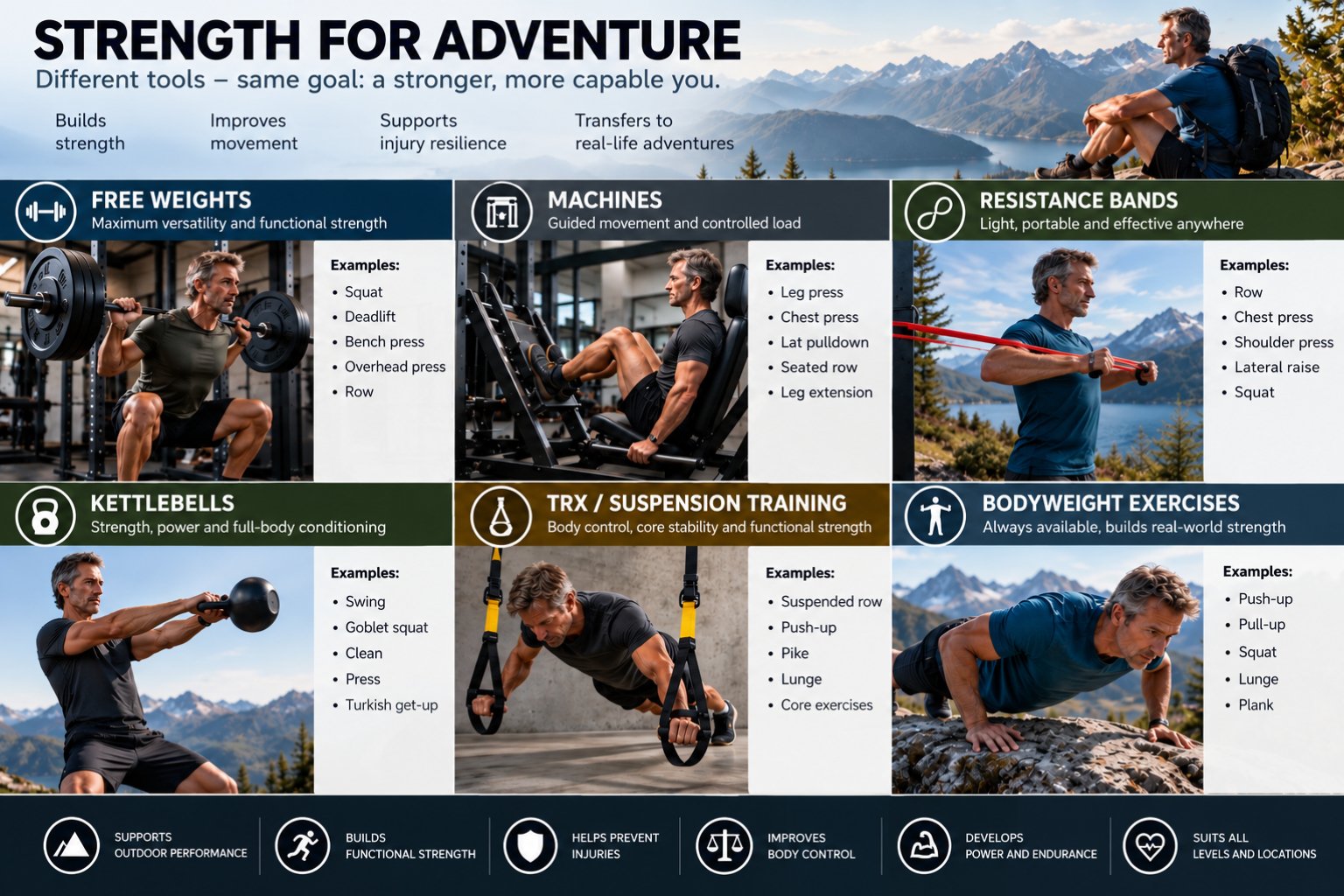
Training for adventures
One of the most useful traditional models is FITT:
F – Frequency: how often?
I – Intensity: how hard?
T – Time: how long?
T – Type: what activity?
But proper training theory goes considerably further.
Overload
The body needs a sufficient stimulus to adapt. If you always perform exactly the same easy activity, improvement eventually plateaus.
Progression
Training stress should increase gradually. For example:
30 km cycling step to 40 km then to 50 km rather than from 30 km immediately step to 120 km.
Specificity
The body adapts specifically to what it repeatedly does. Cycling improves cycling. Climbing improves climbing. Resistance training improves strength. Long aerobic sessions develop endurance-related adaptations. This explains why someone can be extremely fit yet struggle in an unfamiliar sport.
Recovery
Training creates the stimulus. Recovery permits adaptation. Sleep, nutrition, hydration and sufficient recovery time are therefore components of training rather than things separate from it.
Reversibility
Training adaptations diminish when training stops. Hence the expression: “Use it or lose it.”
Individualisation
Identical training doesn’t produce identical responses. Age, genetics, previous training, sleep, nutrition, stress, health and training history all matter.
Major training methods
Continuous aerobic training
Examples:
Cycling, running, hiking, swimming. Usually sustained activity at manageable intensity. It develops aerobic endurance and the ability to maintain work for prolonged periods.
Interval training
Harder efforts alternate with recovery. For example:
4 × 4 minutes hard
with recovery between efforts.
Intervals can efficiently stimulate cardiovascular adaptation.
HIIT
High-intensity interval training involves repeated periods of relatively intense exercise separated by recovery. It can improve aerobic capacity and metabolic fitness but should not replace all lower-intensity training.
Resistance training
Includes:
- free weights
- machines
- resistance bands
- kettlebells
- TRX
- bodyweight exercises.
Its adaptations include improvements in strength, muscle mass, tendon capacity and neuromuscular coordination.
Plyometric training
Explosive movements such as: jumping, hopping and bounding.
These develop the stretch-shortening cycle, power and rapid force production.
Circuit training
Several exercises are performed sequentially. It can combine:
strength + muscular endurance + cardiovascular demand.
Mobility and flexibility work
These aim to maintain or increase usable ranges of movement. Mobility is particularly important because adventure activities often demand movement outside the repetitive patterns of everyday life.
5. Importance of safety in adventure
Safety is not the removal of all risk. That would remove much of what distinguishes adventure from controlled exercise.
The objective is risk management.
A useful sequence is: Identify hazard → estimate likelihood → estimate consequence → reduce exposure → prepare contingency.
For example: Dark clouds appear during a mountain hike.
Hazard: thunderstorm.
Probability: increasing.
Consequence: potentially severe on exposed terrain.
Action: descend, change route or seek appropriate shelter before conditions deteriorate.
Good adventure safety therefore depends heavily on decision-making before an emergency occurs.
The safety system
A competent participant considers:
- weather
- route
- terrain
- personal fitness
- technical competence
- equipment
- clothing
- food
- hydration
- navigation
- communication
- first aid
- emergency exit routes
- group capability.
An important principle is:
Your technical capability should exceed the expected demands of the adventure.
If the environment requires 100% of your capability under normal conditions, you have very little reserve when something goes wrong.
Fatigue deserves particular attention because it simultaneously reduces physical ability and cognitive performance.
6. Energy systems and food
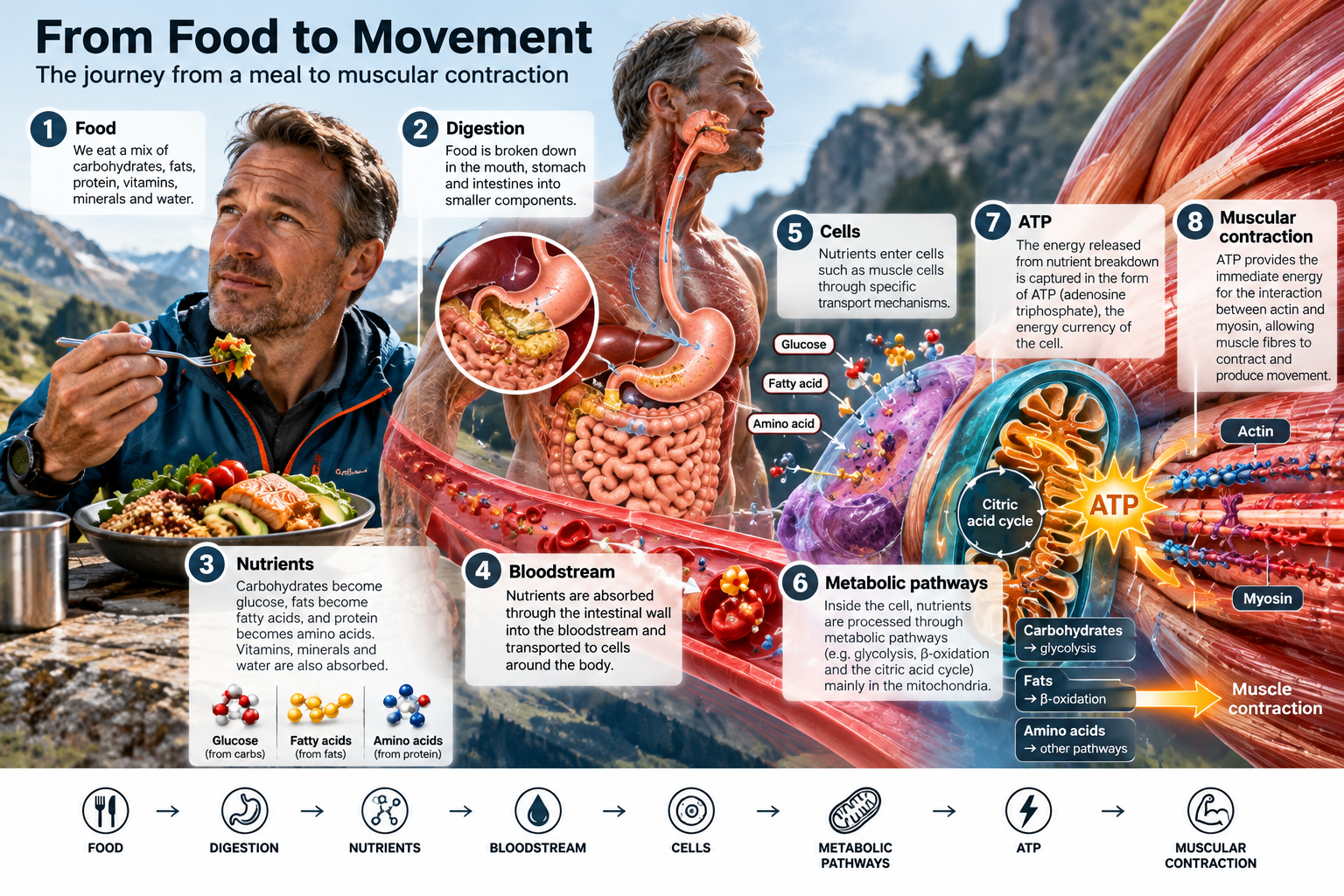
From food to movement
Food → energy
Food doesn’t magically become muscular movement.
It passes through several biological steps.
Very simplified path:
Food – digestion – nutrients – bloodstream – cells – metabolic pathways – ATP – muscular contraction
Carbohydrates
Carbohydrates → glucose. Glucose can be used immediately or stored primarily as glycogen in liver and skeletal muscle. During exercise, muscle glycogen provides an important carbohydrate source.
Fat
Dietary fat is broken into fatty acids and other components. Fatty acids can undergo beta-oxidation and subsequently feed aerobic ATP production. Human fat stores contain enormous potential energy, but fat cannot provide ATP as rapidly as carbohydrate can during high-intensity exercise.
Protein
Protein → amino acids. Its primary roles include structural and functional processes such as tissue maintenance, enzymes and muscle repair/re-modelling.
Protein can contribute to energy production, particularly under certain prolonged-exercise or low-carbohydrate circumstances, but it isn’t normally the body’s preferred primary exercise fuel.
This creates an important endurance principle:
Fat provides enormous capacity; carbohydrate provides faster accessible fuel for harder work.
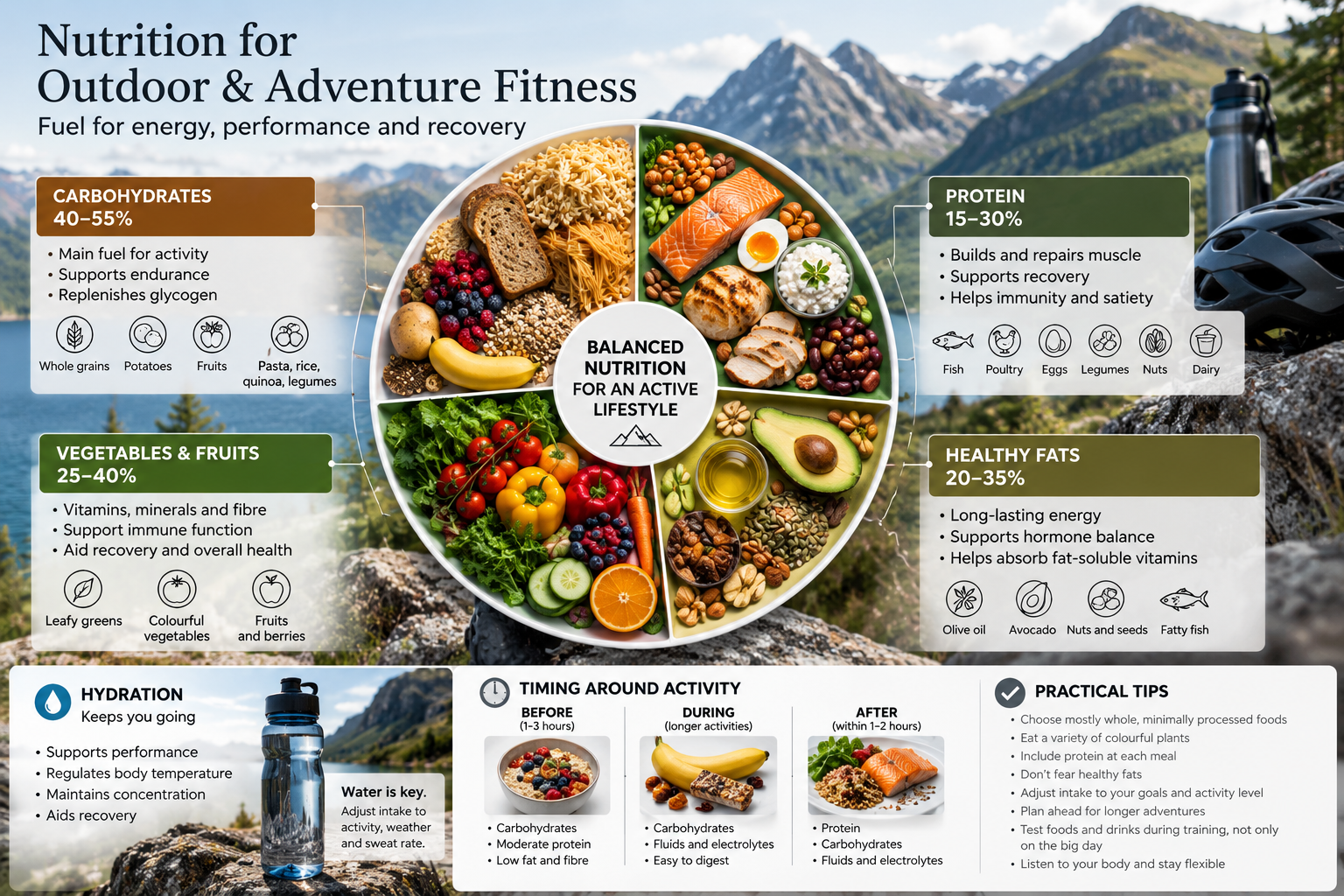
Healthy nutrition habits
7. Intrinsic/extrinsic influences on fitness and socio-cultural considerations
Fitness isn’t determined simply by someone’s willingness to exercise.
Intrinsic influences
These originate primarily within the individual. Examples include:
- age
- biological sex
- genetics
- body composition
- previous fitness
- health status
- injury history
- motivation
- confidence
- personality
- skill
- training history
- sleep
- psychological state.
Some are modifiable. Some aren’t. Genetics cannot be changed through training, but training can strongly influence how an individual’s biological potential is expressed.
Extrinsic influences
These arise from the person’s environment. Examples include:
- access to facilities
- available equipment
- finances
- work schedule
- family responsibilities
- climate
- geography
- coaching
- education
- social support
- transport
- cultural expectations
- safety
- access to green space.
This distinction is extremely important in physical education.
Someone may be highly motivated but have limited time, money, safe exercise environments or access to facilities.
Socio-cultural considerations in physical education
Outdoor fitness operate inside society rather than separately from it.
Participation can be affected by:
Socioeconomic status
Some adventure activities have financial barriers. Walking requires relatively little investment; skiing, sailing or mountaineering may require equipment, transport and instruction.
Gender expectations
Historical and cultural expectations can affect which sports people are encouraged to pursue.
Culture
Attitudes toward outdoor recreation, clothing, competition, mixed-gender participation and risk vary between cultures.
Age
Activities should be adapted rather than assuming everyone requires identical exercise.
Disability and accessibility
Equipment, environments and teaching methods can often be modified to allow much wider participation.
Family and peer influence
People are more likely to participate when activity is normalised and supported within their social environment.
Education
Knowing how to exercise safely dramatically reduces the psychological barrier to participation.
To put this in together I could say, for example, Consider a three-day mountain bike adventure.
Your physiology determines how much power and endurance you possess. Your training determines how well prepared those systems are. Your nutrition supplies energy. Your psychology affects motivation, fear, pacing and decision-making. Your technical skills determine whether you can handle the terrain. Your equipment and financial resources influence accessibility. The environment creates hazards. And your risk-management ability determines whether those hazards become accidents.
Develope five capacities simultaneously:
physical capacity → technical competence → psychological capacity → environmental knowledge → risk-management ability.
Images created in cooperation with AI