
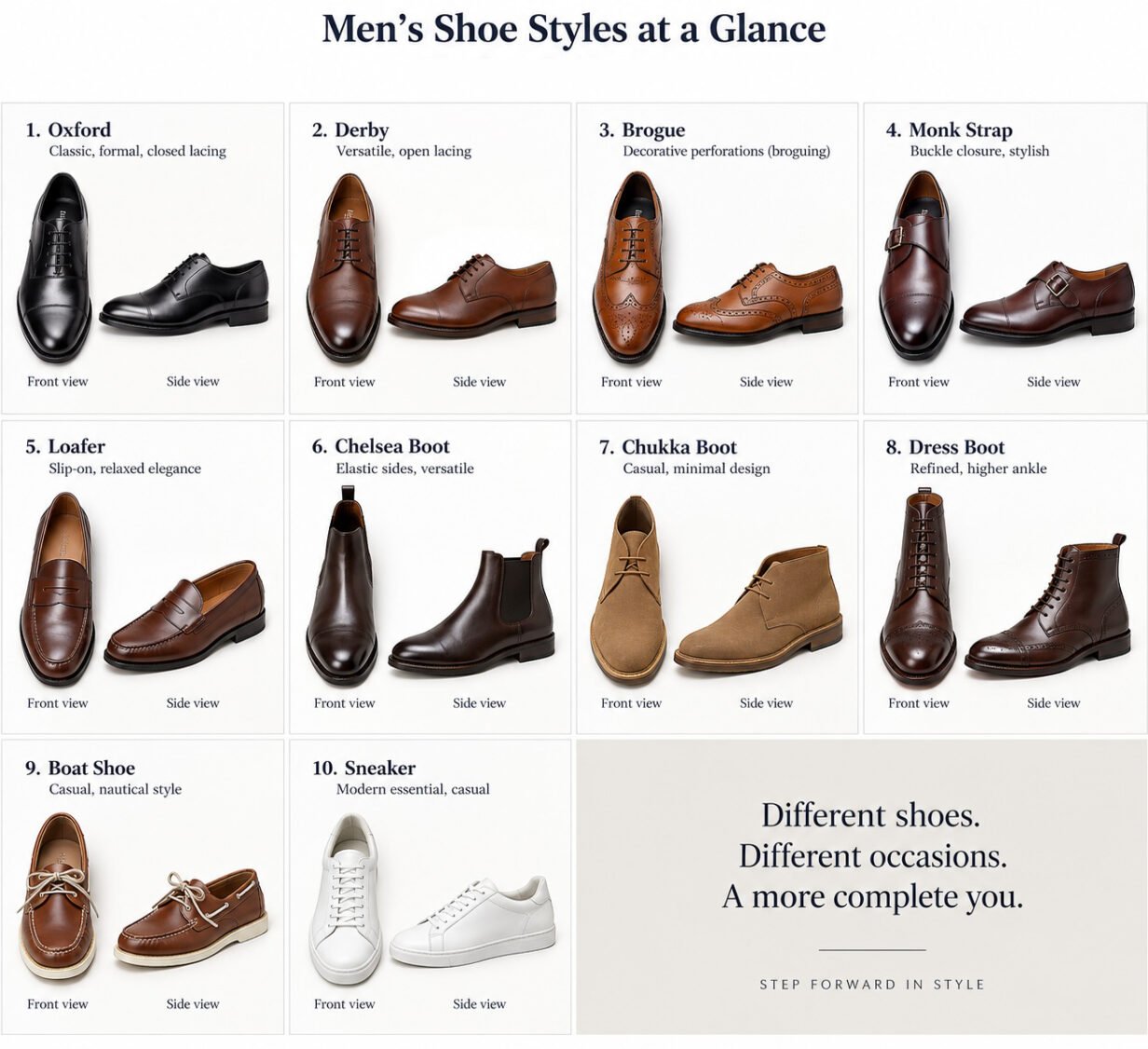
A Man’s Guide to Shoes, Style and Occasion
Shoes are funny things. Long time ago during my studying time I didn’t care too much about shoes. Whatever happened to be available close to outdoor it was my choice.
That was then this is now. Our family business partly relies on shoes, so careless days are history.
Today, if I participate some event, I often notice what kind of footwear person have. It’s like a silent part of signature outlook and personal brand.
Still, generally speaking, for many shoes are not always on top priority or even close. For someone of course they are a part of identity.
We spend plenty of time thinking about jackets, shirts, trousers and watches, yet shoes are often chosen almost as an afterthought. And they shouldn’t be. You can put together an excellent outfit and still get the whole thing slightly wrong with the shoes.
The reverse is true as well. Good shoes can make a fairly ordinary combination of trousers, shirt and jacket suddenly look intentional.
There is even some research behind the idea that shoes communicate something about us. A study published in the Journal of Research in Personality found that people were able to make surprisingly accurate judgements about certain characteristics of strangers simply from photographs of the shoes they wore most often.
Perhaps we notice footwear more than we realize.
Still, men’s shoes can seem unnecessarily complicated. Oxford, Derby, brogue, monk strap, loafer, Chelsea, chukka… and then we start talking about lasts, welts, suede, calfskin and shell cordovan.
It really isn’t as complicated as it sounds.
Once you understand a few basic families of shoes, and what separates one from another, choosing the right pair becomes much easier.
First, Forget the Idea That Shoes Are Simply Formal or Casual
It is more useful to think of men’s footwear as a spectrum.
At one end you might have a sleek black cap-toe Oxford: polished leather, thin sole, restrained detailing. Clearly formal.
At the other end there might be a canvas sneaker or rugged work boot.
Between those two extremes lies most of the interesting territory: suede Derbys, loafers, brogues, Chelsea boots, chukkas, leather sneakers and boat shoes.
Material matters. Colour matters. The shape of the shoe matters. Even the sole can change its character.
A dark-brown suede Derby, for example, feels considerably more relaxed than the same basic shoe made from highly polished black calfskin.
So rather than asking only, “What type of shoe is this?”, ask another question:
“What version of this shoe is it?”
That distinction becomes important.
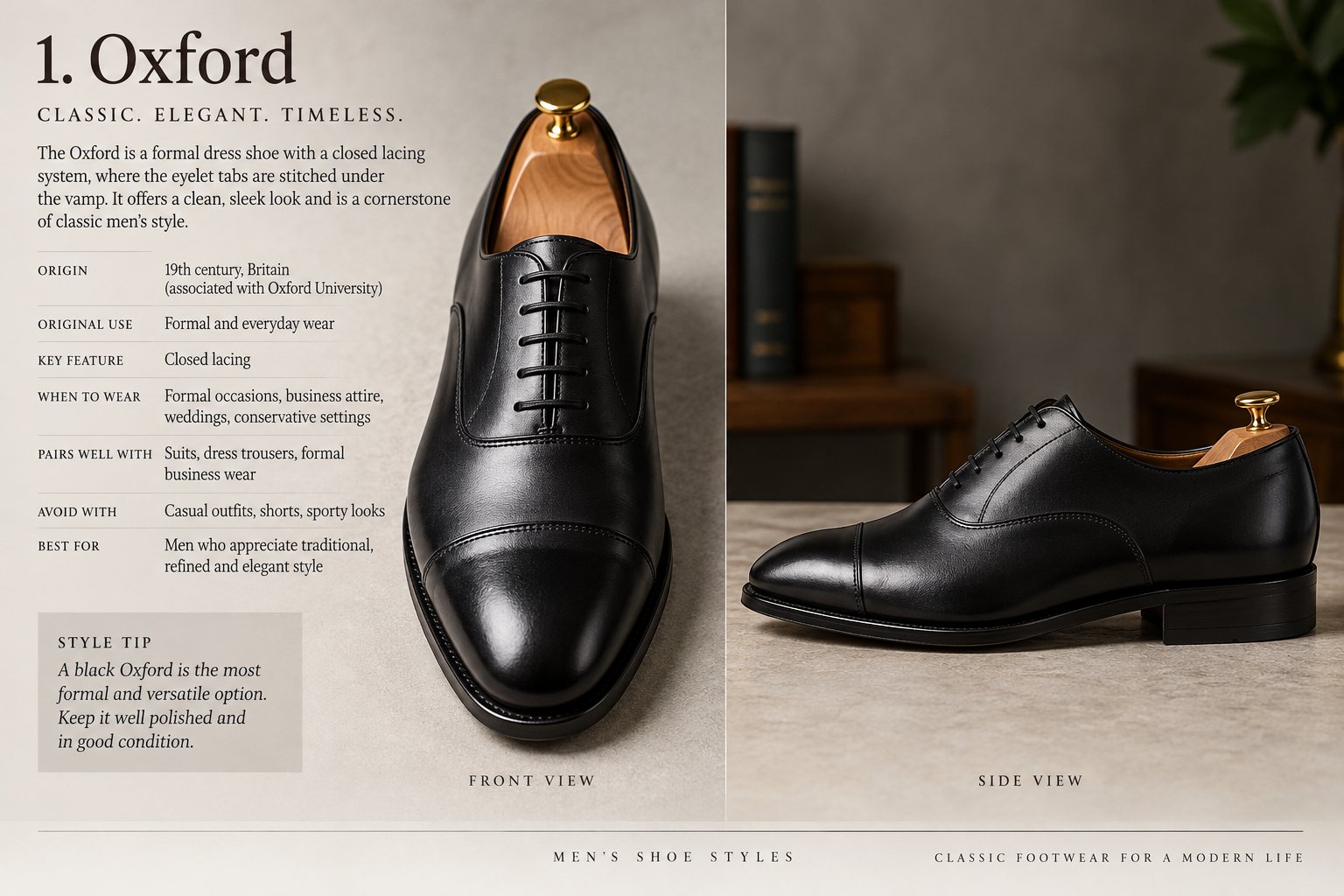
1. Oxford The Refined Classic
Oxford
How to recognise it
The defining feature of an Oxford is its closed lacing system. The quarters, the sections of leather containing the eyelets, are sewn underneath the vamp.
That sounds technical, but visually it produces a very clean, controlled appearance.
And that is exactly why the Oxford has become one of the foundations of traditional men’s formal footwear.
Where did it come from?
The precise origin isn’t as tidy as some shoe-company histories suggest. The style developed in Britain during the nineteenth century and is associated with an earlier ankle boot known as the Oxonian, reportedly popular among students at Oxford University.
Over time, the boot became lower and evolved toward the shoe we recognise today.
In the United States, you may also encounter the word Oxford being used much more loosely for lace-up shoes. In classic menswear terminology, however, closed lacing is the important feature.
When does it work?
A black cap-toe Oxford is one of the safest choices for conservative business dress, weddings, funerals and other formal occasions.
Dark brown makes the Oxford slightly less severe and works beautifully with navy, grey and many earth-toned suits.
Tan Oxfords are considerably more casual.
Best suited to
The Oxford suits the man who likes clean lines, traditional tailoring and understatement.
If your wardrobe revolves around suits, tailored trousers, crisp shirts and structured jackets, Oxfords will feel completely natural.
With distressed denim and a casual T-shirt? Usually not. There are better shoes for that job.
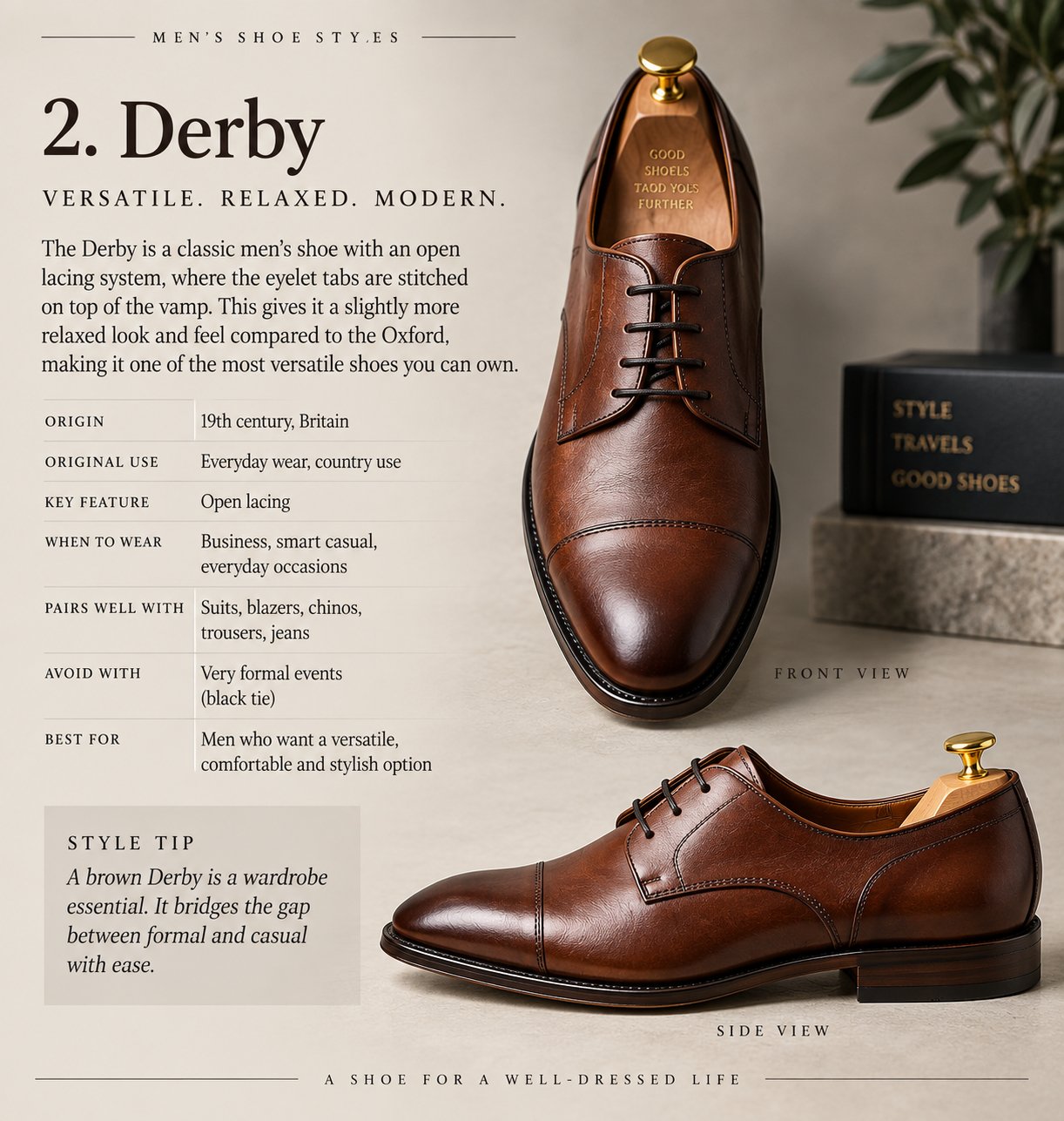
2. Derby The Oxford’s More Relaxed Cousin
Derby
Put an Oxford and Derby beside each other and many men initially struggle to tell them apart.
Look at the laces.
A Derby has an open lacing system. The quarters sit on top of the vamp rather than being tucked beneath it.
The difference seems tiny. Visually, however, the Derby tends to look slightly less formal and often feels a little more accommodating across the instep.
When does it work?
Almost everywhere short of the most formal situations.
A sleek black Derby can still work with business tailoring. A brown Derby is excellent with chinos, flannel trousers, tweed, corduroy and smart denim.
Change the leather to suede and the character changes again.
A chocolate-brown suede Derby with grey flannel trousers, for example, is one of those combinations that looks stylish without appearing as though you spent half the morning trying to look stylish.
Best suited to
The Derby is particularly useful for the man whose wardrobe sits somewhere between tailoring and relaxed clothing.
If you rarely wear full suits but frequently wear blazers, chinos, wool trousers and good denim, the Derby may actually be more useful than the Oxford.
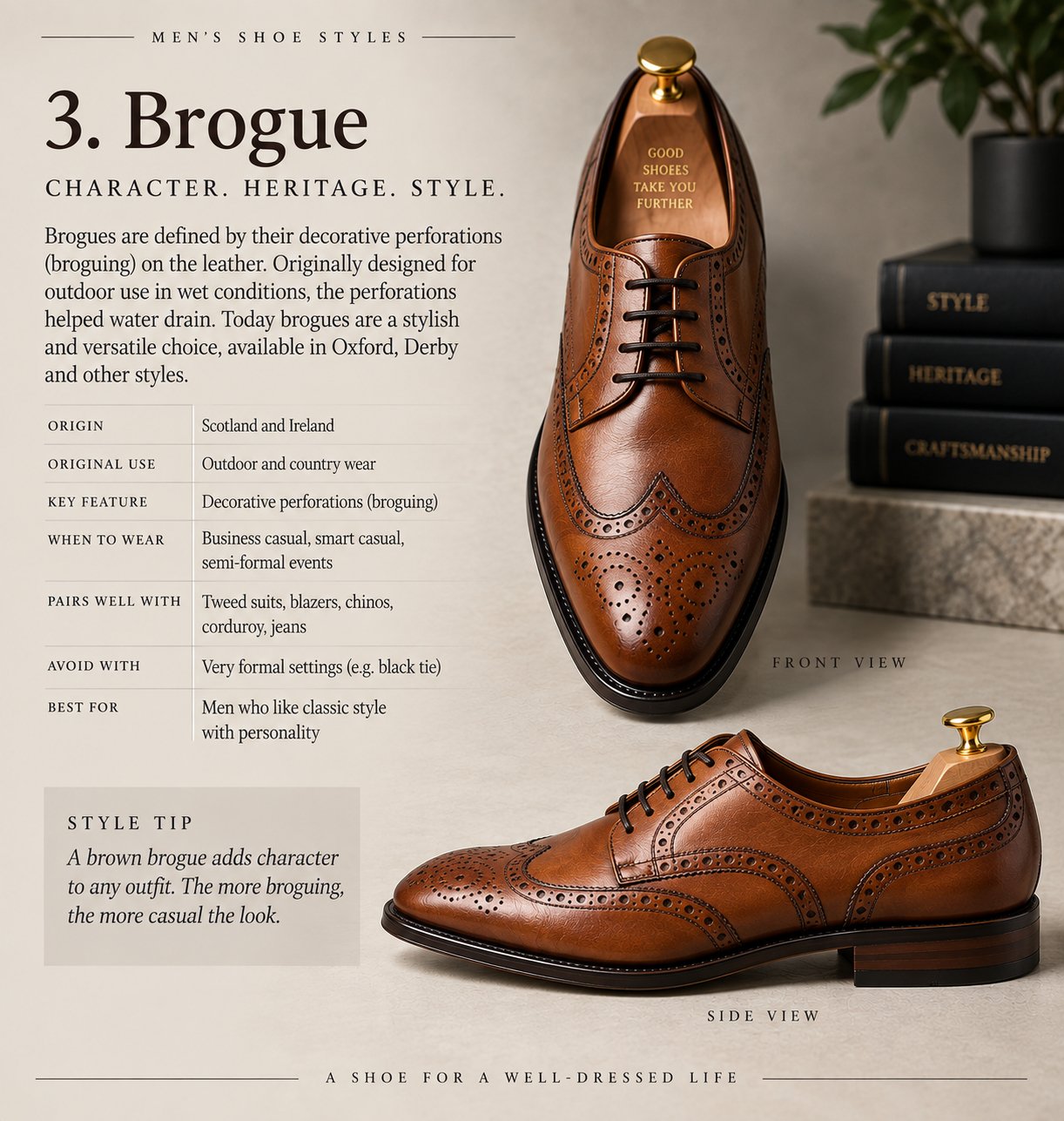
3. Brogues, it’s the Decoration, Not the Shoe
Broque
This is one of the most misunderstood terms in men’s footwear.
A brogue is defined by broguing – decorative perforations in the leather.
That means a shoe can be both an Oxford and a brogue. Or a Derby and a brogue.
Originally, perforated footwear was associated with practical outdoor shoes in Britain and Ireland. The holes are often said to have helped water drain from footwear used in wet country terrain. Over time, the functional idea evolved into decorative detailing and eventually entered mainstream menswear.
Today we generally distinguish between:
Quarter brogue, restrained perforation around the toe-cap seams.
Semi-brogue, additional perforation and decoration on the toe.
Full brogue or wingtip, the familiar W-shaped toe design with more extensive decoration.
As a rough rule, more broguing tends to make a traditional dress shoe look more decorative and somewhat less formal.
What should you wear them with?
Brogues are superb with textured clothing.
Think tweed, flannel, corduroy, heavier chinos and denim.
A brown full-brogue Derby with a tweed jacket feels completely at home. A heavily brogued tan shoe underneath a very conservative dark business suit can be less convincing.
Best suited to
The man who appreciates classic style but doesn’t want it to feel overly corporate.
Brogues have character. They look particularly good on someone whose style leans British country, heritage, traditional European or smart casual.
4. Monk Straps for a Little More Personality
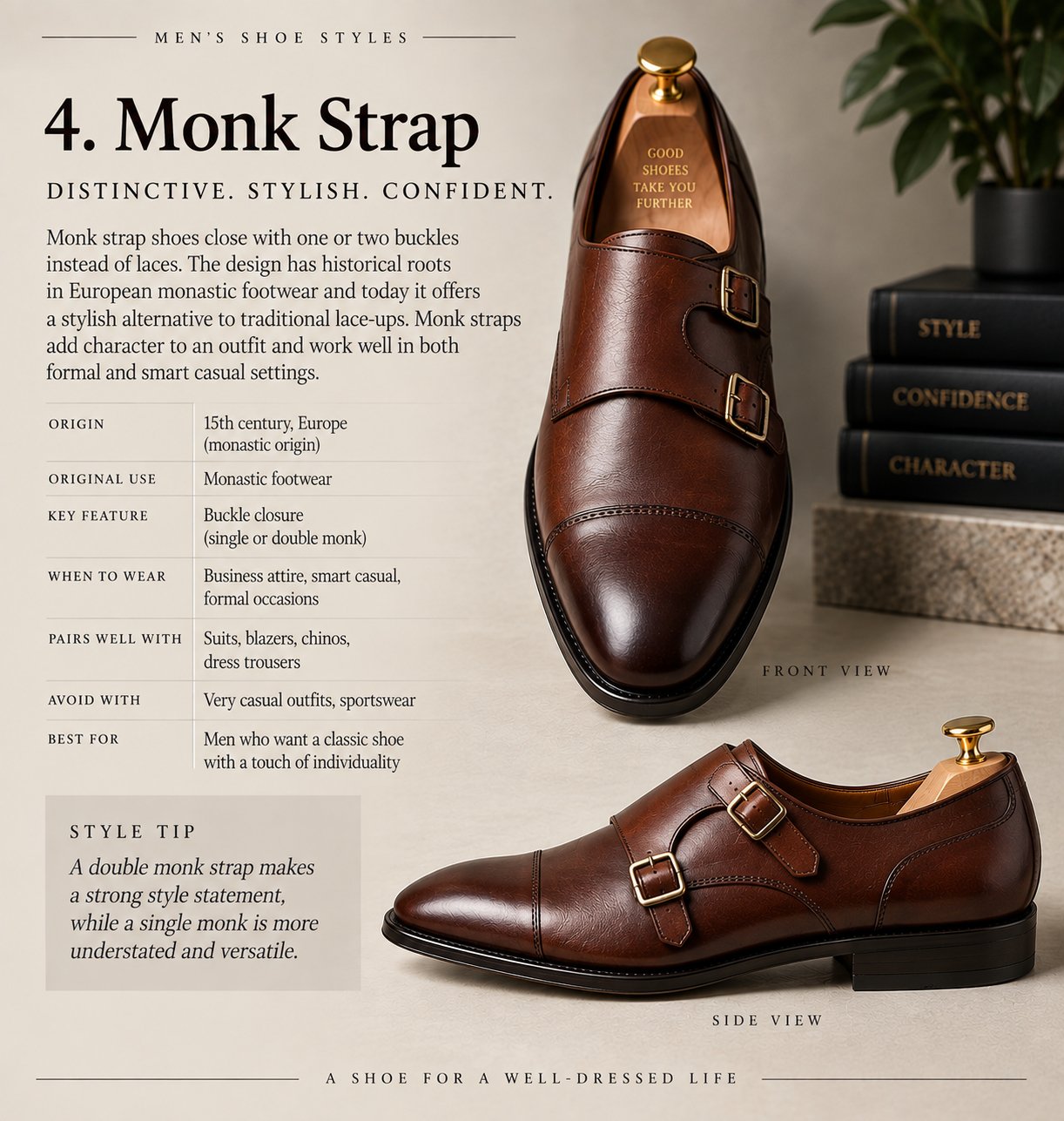
Monk Strap
The monk strap immediately separates itself from the Oxford and Derby because there are no laces.
Instead, the shoe closes with one or two buckled straps.
Hence the familiar distinction between single monk and double monk.
The design is generally linked to buckled footwear historically associated with European monks, although the modern dress shoe is obviously a much more refined descendant.
A monk strap occupies an interesting position.
It is elegant enough for tailoring but unusual enough to attract attention.
When does it work?
Brown or burgundy monk straps are excellent with tailored trousers, blazers and suits.
Double monks often feel a little more expressive; single monks can appear cleaner and more restrained.
I wouldn’t choose them for the most conservative formal occasions. That isn’t really where they shine.
Best suited to
Someone who understands classic menswear but doesn’t want to look completely conventional.
A monk strap says just a little more than an Oxford does.
Sometimes that’s exactly the point.
5. Loafers, Relaxed Elegance Done Properly
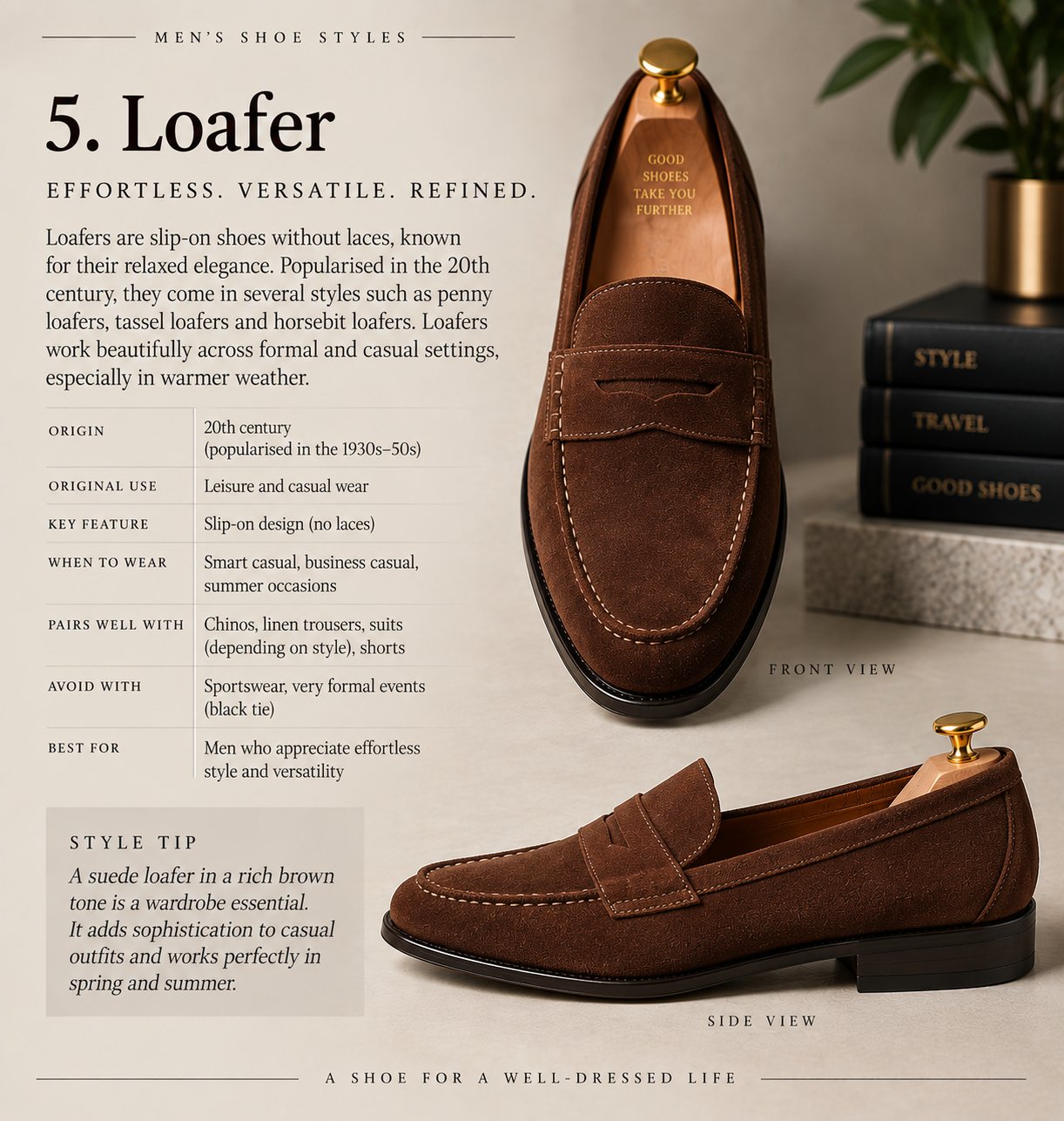
Loafers
Few shoes cover as much territory as the loafer.
It has no lacing system and is simply slipped onto the foot, but within that basic idea there are several distinct styles. The three worth knowing are:
Penny loafer — classic, understated and highly versatile.
Tassel loafer — slightly more decorative and often dressier.
Horsebit loafer — recognisable by the metal bit across the vamp, famously associated with Gucci since the 1950s.
Loafers are particularly interesting because they move so easily between different worlds.
A polished black leather loafer can accompany tailoring. A dark-brown suede penny loafer works beautifully with chinos. A soft suede loafer can look completely at home with linen trousers on a Mediterranean summer evening.
Socks or no socks?
Both can work.
With tailoring, socks usually create the more traditional appearance.
With linen, chinos or summer trousers, an exposed ankle can look natural. Invisible socks are often the more comfortable and hygienic solution if you want that appearance.
Best suited to
Loafers suit someone who prefers elegance without stiffness.
They belong naturally to Italian-inspired wardrobes, Ivy and preppy style, summer tailoring and relaxed business clothing.
And they age well stylistically. A good loafer looks perfectly appropriate on a man of 25 or 65.
6. Chelsea Boots Clean, Simple and Slightly Rock ‘n’ Roll
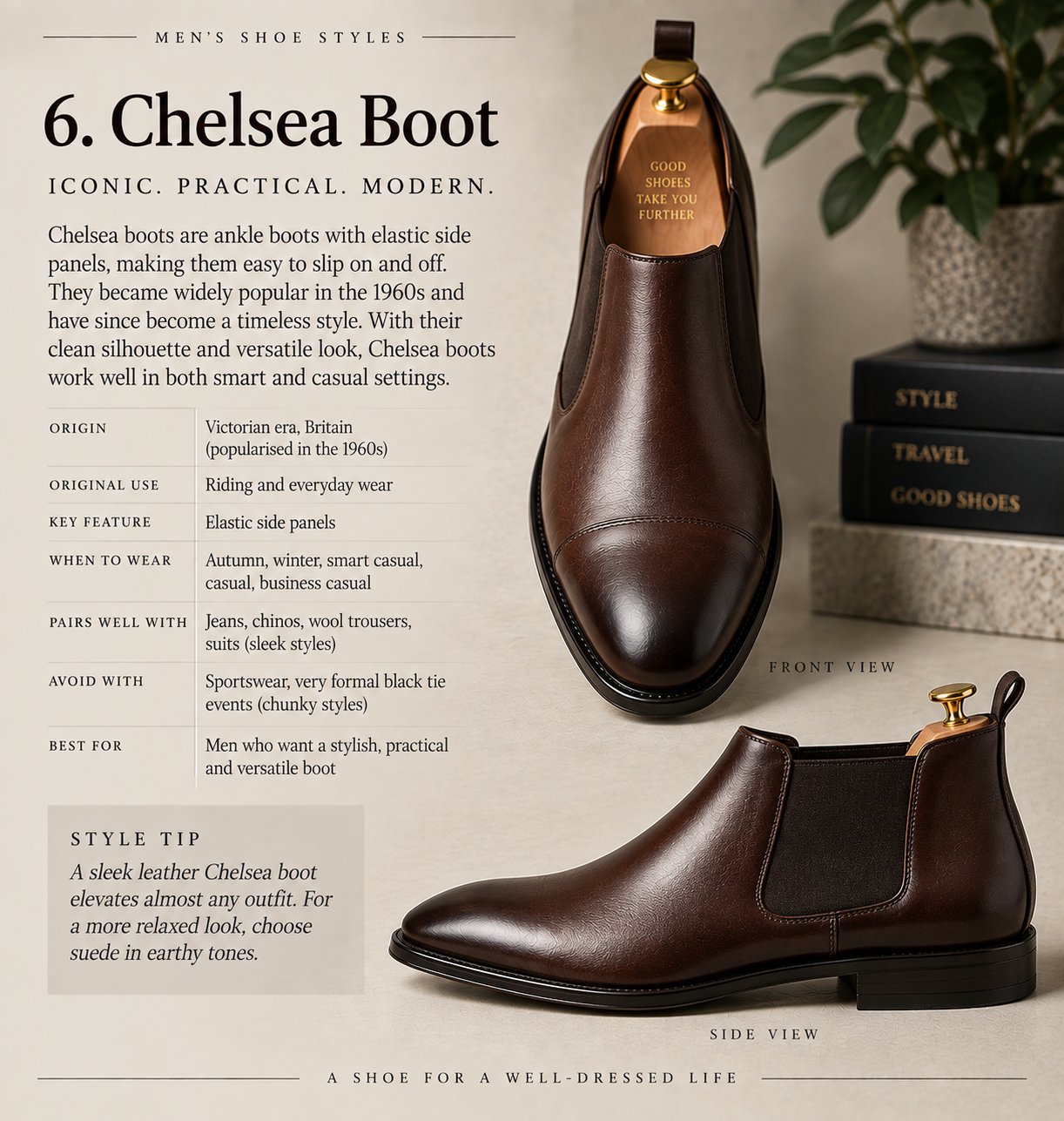
Chelsea Boots
Chelsea boots are ankle boots without conventional laces, recognised by the elastic panels on their sides.
Their modern history goes back to Victorian Britain. Shoemaker J. Sparkes-Hall is associated with creating elastic-sided boots for Queen Victoria after vulcanised rubber made elastic inserts practical.
Much later, the boot became strongly associated with London’s Chelsea scene and the style culture of the 1960s. 3That history explains something about the Chelsea boot.
It can be elegant, but it also has attitude.
How to wear them
A sleek black Chelsea boot works brilliantly with dark trousers, a roll-neck, an overcoat or a minimalist suit.
Brown suede versions are considerably more relaxed and pair naturally with denim and chinos.
But pay attention to shape.
A narrow, elegant Chelsea boot with a fine sole and a chunky Chelsea boot with a heavy lugged sole may technically belong to the same family, but stylistically they are completely different shoes.
Best suited to
The man who likes minimalism but wants something stronger than an ordinary dress shoe. Chelsea boots work especially well with modern European, minimalist, rock-influenced and contemporary tailored wardrobes.
7. Chukka Boots, Relaxed Without Looking Sloppy
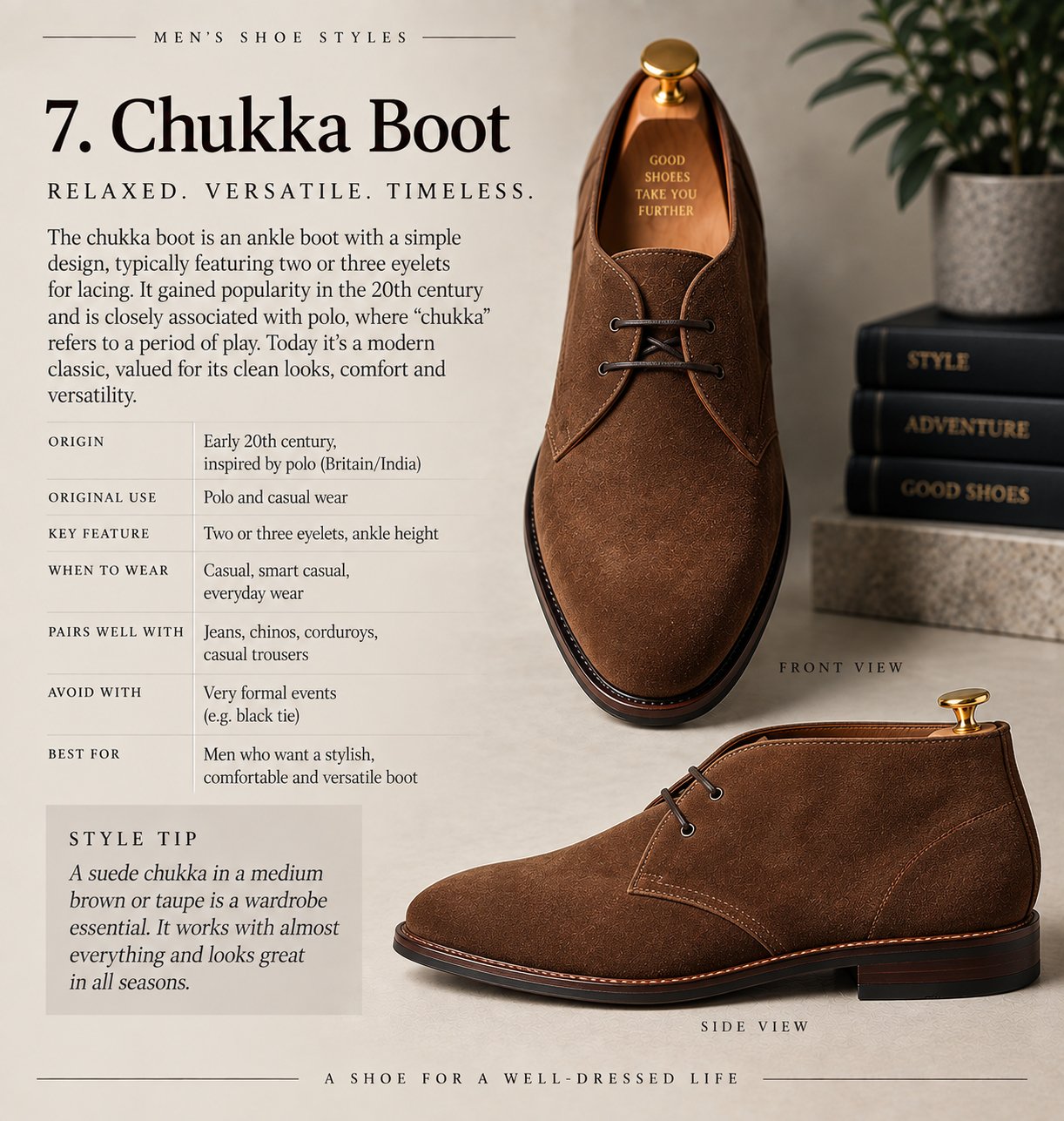
Chukka Boots
A typical chukka is an ankle-height boot with a relatively simple upper and usually two or three pairs of eyelets.
The style became particularly popular in the twentieth century and has connections with polo — a chukka is also a period of play in a polo match. One particularly famous relative is the desert boot, popularised by Clarks after Nathan Clark encountered simple suede boots worn in Cairo during the Second World War.
Not every chukka is a desert boot, however. That distinction is worth remembering.
What works with them?
Suede chukkas are exceptionally easy to wear. Jeans. Chinos. Corduroy. Casual wool trousers. A medium or dark-brown suede chukka may be one of the most useful shoes a man can own during autumn. They generally don’t belong with formal business suits, although particularly sleek leather versions can work with relaxed tailoring.
Best suited to
Someone who values comfort and understatement. They are ideal for a man who wants to dress well without looking formally dressed.
8. Dress Boots When a Shoe Isn’t Quite Enough
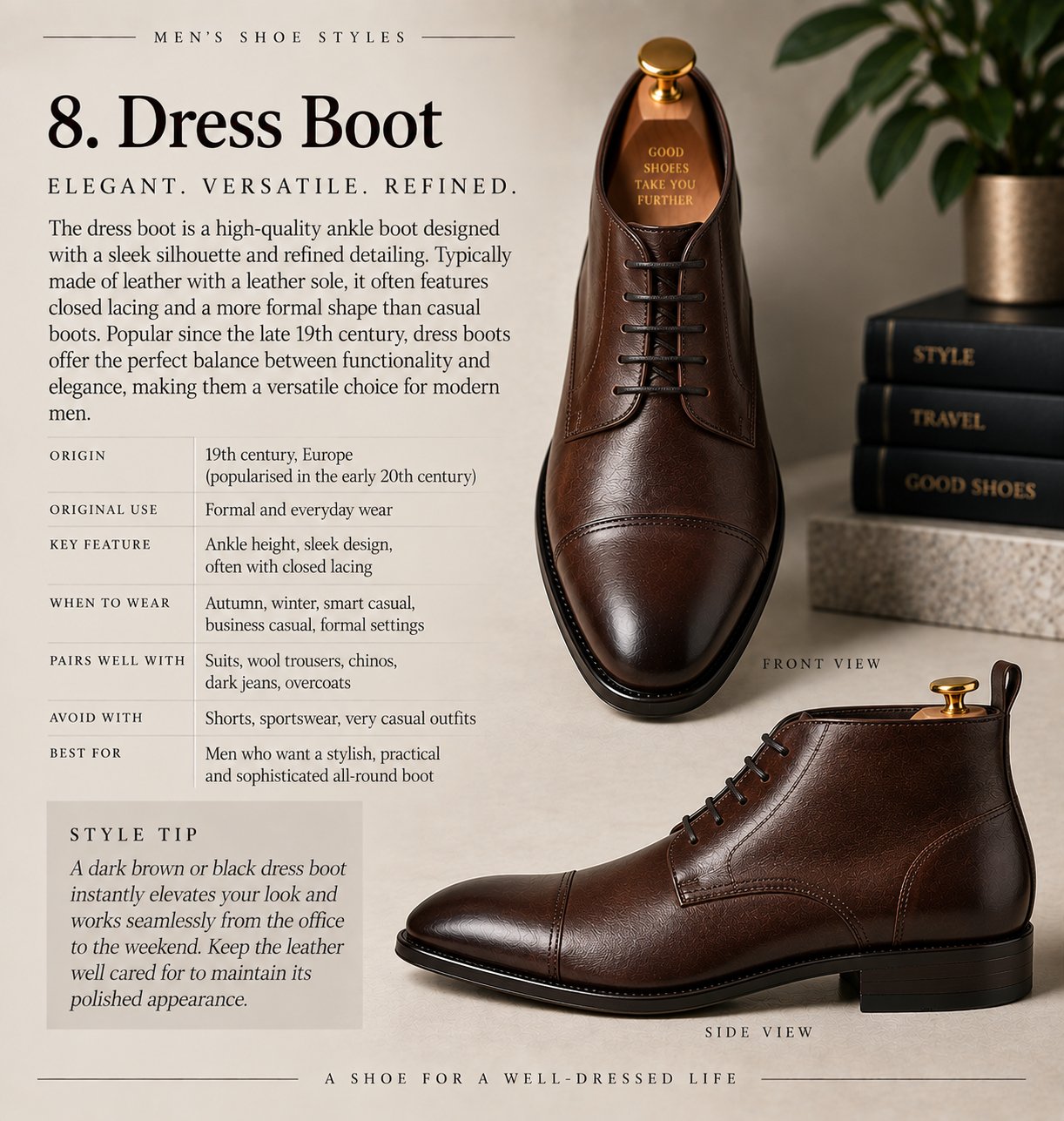
Dress Boots
Dress boots essentially bring the refinement of a dress shoe above the ankle.
You will find Oxford-style boots, Derby boots, brogued boots and other variations. They make particular sense in colder climates because they offer greater coverage while retaining a relatively elegant silhouette.
Dark leather dress boots can work extremely well with wool trousers, overcoats and winter suits. But there is an important distinction.
A dress boot is not automatically a formal shoe simply because it is made from polished leather.
For highly formal evening dress, conventional formal shoes remain the safer choice. A tuxedo, for example, traditionally calls for very refined black footwear rather than an ordinary dress boot.
Best suited to
Men who live in cooler climates, wear tailoring during autumn and winter, and want practicality without moving into rugged outdoor footwear.
9. Boat Shoes From Wet Decks to Summer Style
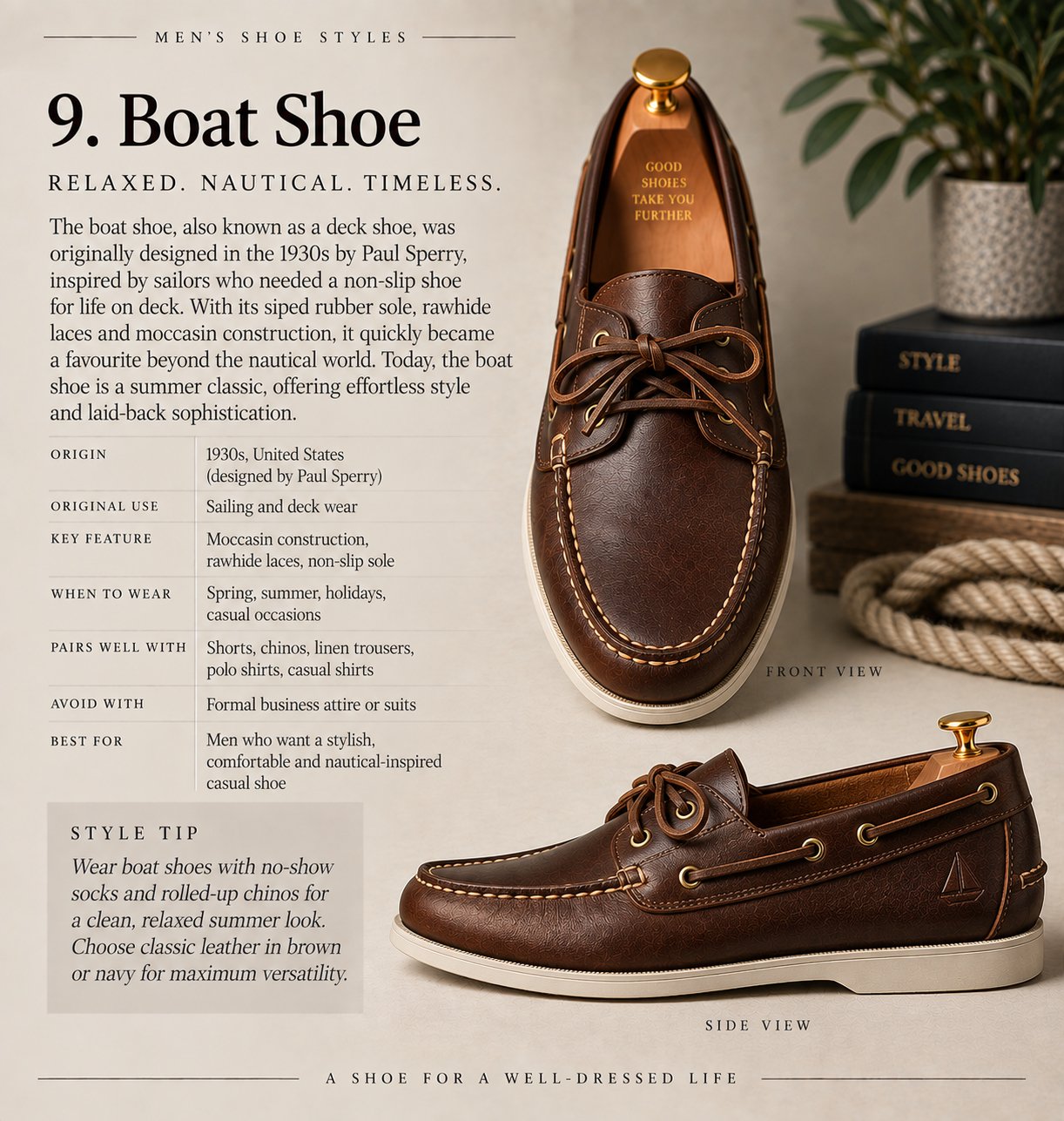
Boat Shoes
Here we have a shoe whose original purpose is unusually easy to identify.
Paul Sperry developed non-slip deck footwear in the 1930s after experimenting with grooves cut into rubber soles. Sperry dates the invention to 1935; the company says the leather Authentic Original followed in 1937.
The important features were practical: grip on wet decks, non-marking rubber soles and a comfortable moccasin-style upper.
Eventually the boat shoe left the boat. It became associated with American preppy style, coastal clothing and relaxed summer wardrobes.
How to wear them
Boat shoes work with:
chinos, shorts, polo shirts, Oxford shirts, linen and other relaxed summer clothing.
What they don’t particularly enjoy is formal tailoring. A boat shoe underneath a serious business suit usually looks like somebody changed clothes but forgot to change his shoes.
Best suited to
Relaxed, preppy, coastal and sporty-classic wardrobes. And yes, they look especially convincing near water. But owning a yacht is thankfully not part of the dress code.
10. Sneakers The Modern Essential
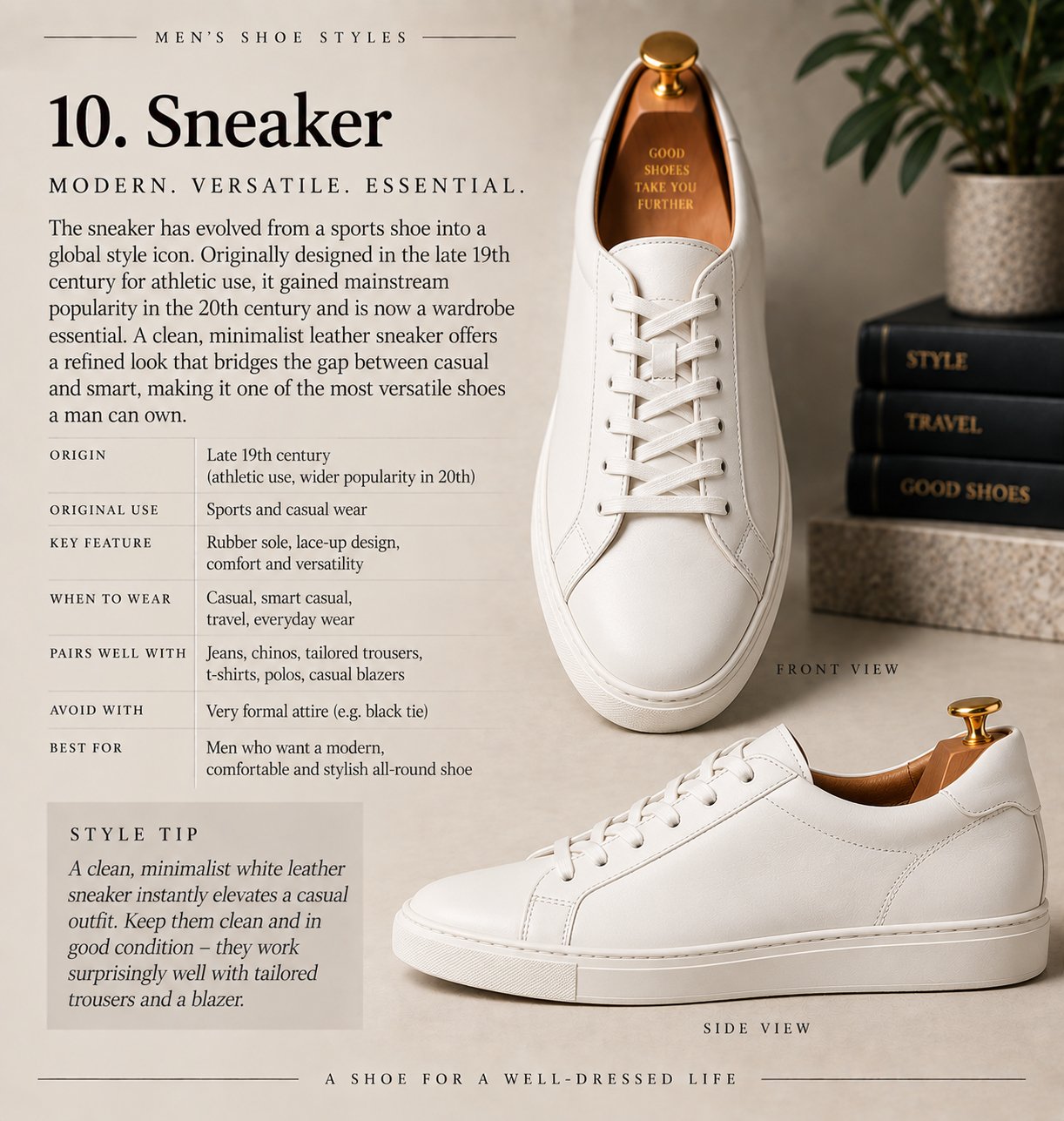
Sneakers
Sneakers deserve their own article because the category has become enormous.
Running shoes, basketball shoes, retro trainers, minimalist leather sneakers and canvas tennis shoes may all technically fall under the broad sneaker umbrella, but stylistically they have very little in common.
For an adult wardrobe, I would separate them roughly into two worlds.
Athletic sneakers belong naturally to sportswear and very casual outfits.
Minimalist lifestyle sneakers, particularly clean leather designs, can work with chinos, tailored casual trousers and unstructured jackets.
The white leather sneaker has become something of a modern classic. Still, context matters.
A minimalist white sneaker worn with an unstructured navy jacket and chinos can look excellent. The same shoe at a conservative formal business meeting may simply look too casual. Modern dress codes have relaxed considerably, but they haven’t disappeared entirely.
Materials Matter More Than You Think
Two shoes with exactly the same construction can communicate very different things simply because of the material.
Calfskin and smooth leather
Smooth leather remains the traditional choice for dress shoes. It can take a polish, develops character with age and works particularly well when a clean, refined appearance is required.
Generally, the smoother and darker the leather, the more formal the shoe appears.
Suede
Suede changes the mood immediately. It absorbs light rather than reflecting it, creating a softer and more relaxed appearance. That makes suede wonderful with textured fabrics — flannel, linen, corduroy, denim and casual wool.
Don’t think of suede as merely a casual material, though. A beautifully made dark-brown suede loafer or Derby can be extremely sophisticated.
Shell Cordovan
Shell cordovan deserves a category of its own.
It is made from a particular membrane beneath the hide of a horse’s rump and is prized for its durability, lustre and distinctive way of developing rolls rather than the fine creasing normally seen in calfskin.
It is also expensive.
And one small terminology trap: cordovan can refer to the material, while the word is also commonly used to describe a deep reddish-brown colour. A cordovan-coloured shoe isn’t necessarily made from shell cordovan.
Canvas
Lightweight, breathable and informal. Canvas belongs naturally to summer sneakers, espadrilles and some deck shoes. It isn’t luxurious in the traditional sense — and doesn’t need to be. Sometimes a simple navy or off-white canvas shoe is exactly right.
Colour Changes the Formality Too
If you’re building a wardrobe rather than collecting shoes randomly, colour deserves some thought.
Black is generally the most formal and urban.
Dark brown is exceptionally versatile and softer than black.
Medium brown moves easily through business casual and smart casual.
Tan attracts more attention and generally feels more casual.
Burgundy or oxblood is one of the great underestimated menswear colours. It combines surprisingly well with navy, grey, brown and denim.
And then there is suede, where navy, taupe, grey and even muted green can become remarkably wearable.
You don’t need twenty colours.
You need the right few.
Fit Comes Before Style
There isn’t much point owning beautiful shoes if you hate walking in them. And fit isn’t merely a matter of comfort.
Research reviewing footwear fit has found associations between incorrectly fitted footwear and foot pain and problems including corns and calluses. One review found that a surprisingly large proportion of participants in the studies examined were wearing footwear that didn’t properly accommodate the length or width of their feet. So don’t assume that your usual numerical size automatically means the shoe fits.
Different manufacturers use different lasts — the three-dimensional forms around which shoes are constructed. Two shoes marked EU 43 can therefore feel completely different.
Your heel should feel secure. Your toes need adequate room. The widest part of your foot should correspond reasonably well with the widest part of the shoe.
And don’t buy painfully tight shoes because somebody tells you, “Don’t worry, they’ll stretch.”
Some leather will soften and adapt. A badly fitting shoe is still a badly fitting shoe.
Take Care of Good Shoes
Quality footwear can last for many years, but leather needs a little help.
You don’t need an entire cupboard of shoe-care products. For good leather shoes, a basic routine is enough:
- Clean them when necessary
- Use an appropriate leather conditioner occasionally
- Polish smooth leather when needed
- Use shoe trees, particularly with quality dress shoes
- Allow shoes to dry naturally if they become wet
And, ideally, don’t wear the same leather shoes every single day. Giving them time to dry between wears helps the leather recover.
Suede needs a different approach: a suede brush and suitable protective products rather than conventional leather polish. Good shoes often become more attractive as they age.
Neglected shoes merely become old.
So, Which Shoes Should a Man Actually Own?
There is no universal list.
A lawyer working in a conservative office in London needs a very different shoe wardrobe from a creative professional working remotely in Milan — and both are different from a man whose weekends involve boats, gravel roads and hiking trails.
Build around your actual life. If you wear suits regularly, a black or very dark Oxford deserves serious consideration.
If your world is mainly smart casual, a brown Derby may be far more useful.
If you love relaxed Italian style, start looking at loafers.
If your wardrobe consists largely of good denim, chinos, knitwear and jackets, suede chukkas and Chelsea boots suddenly make a great deal of sense.
And if most of your life is genuinely casual, there is nothing wrong with investing in excellent sneakers rather than buying formal shoes that spend eleven months of every year sitting in a wardrobe. Style should serve your life, not an imaginary version of it.
Like Columbo used to say: One More Thing.
Shoes Say Something
Not necessarily your wealth. Not necessarily your profession. And certainly not your entire personality. But they do say something about how you approach clothes. There is a difference between a man wearing expensive shoes and a man wearing the right shoes.
The latter understands context.
He knows why black Oxfords belong in certain rooms, why suede loafers feel wonderful on a summer evening, why Chelsea boots can give an otherwise conservative outfit a little edge, and why battered running shoes probably shouldn’t accompany a carefully tailored jacket simply because they’re comfortable.
Once you start noticing these differences, men’s shoes stop being complicated.
They become interesting. And perhaps that is the best place to begin: don’t buy shoes simply because someone says every man must own them.
Understand what they are. Understand where they came from. Then decide whether they belong in your wardrobe.
All-in-One
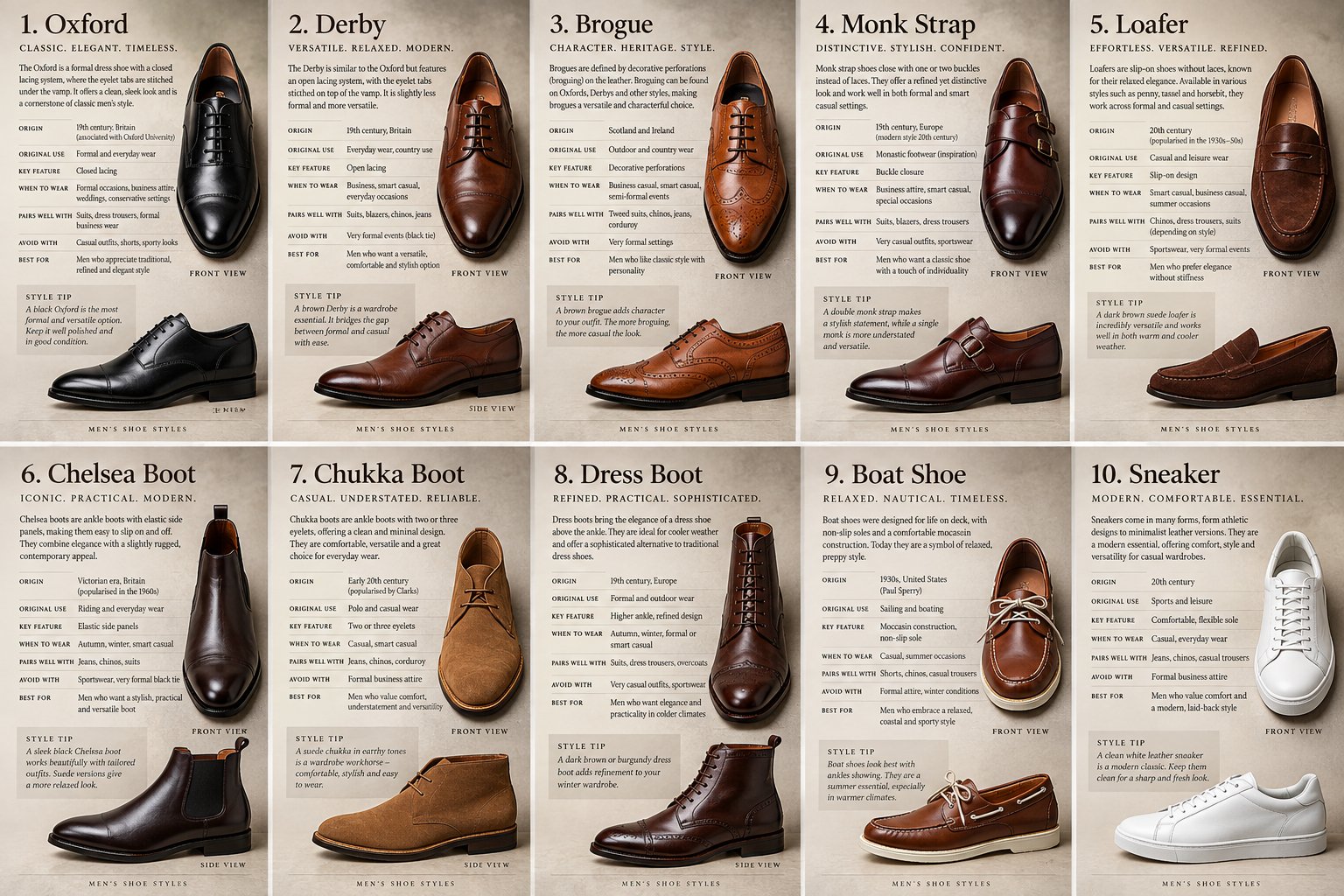
All-in-One
Good link to up-to-date men’s style guide
Images created in cooperation with AI