
Exercise benefits the brain first – A powerful fact that rarely gets attention
Long before your body shows visible changes. Most people believe they train to lose weight or build muscle, but science shows that exercise benefits the brain first by improving decision-making, stress resilience, focus, and emotional control.
Let me guess you’ve been meaning to get back into a consistent training routine. Maybe you’ve even started a few times. The motivation? Probably something about losing weight, building muscle, or fitting into those jeans from 2019.
Here’s what nobody tells you: your brain is already benefiting from exercise before your body shows a single visible change.
And I’m not talking about feeling good or clearing your head. I’m talking about measurable, structural changes in the part of you that runs your entire life: your decision-making, your stress response, your ability to focus during that critical client meeting.
Why exercise benefits the brain first
Here’s the thing most people misunderstand: your brain didn’t evolve to do spreadsheets or sit through Zoom calls. It evolved to move your body through space to hunt, to navigate, to survive, to connect with others.
So, when you train your body, you’re not doing your brain a favor. You’re giving it what it’s been screaming for while you’ve been sitting in traffic and staring at screens.
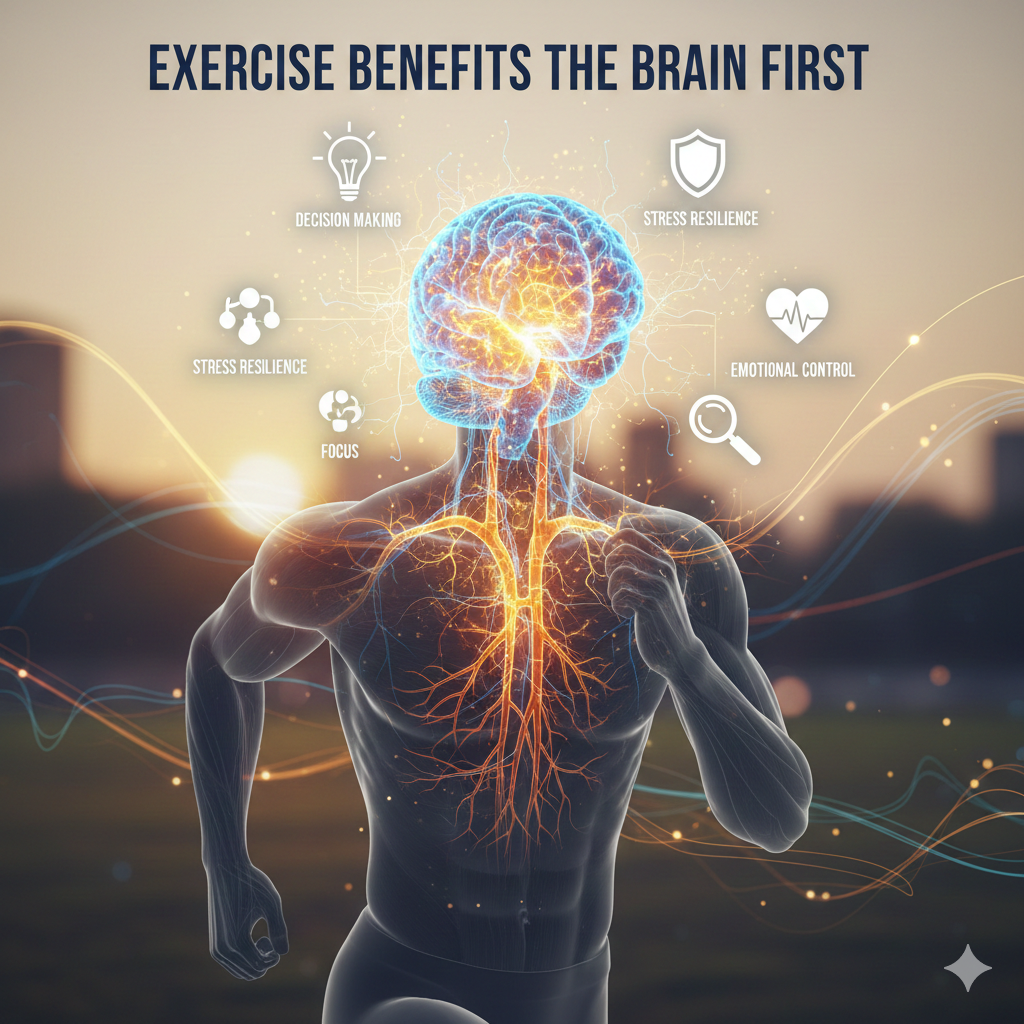
Exercising person and image tells how brain benefits from training
What Happens in the First 20 Minutes
Forget about seeing abs. Within minutes of starting physical activity, your brain is already throwing a neurochemical party:
BDNF floods your system – scientists literally call this “fertilizer for the brain.” It’s rebuilding neural connections, making you sharper, helping you learn faster.
Dopamine spikes – suddenly that project you’ve been avoiding doesn’t seem so daunting. Your motivation system just got a reset.
Norepinephrine kicks in – your attention sharpens. That fog you’ve been working through? It’s lifting.
Serotonin stabilizes your mood – the irritability that’s been following you around starts to fade.
This is happening before you’ve burned a meaningful number of calories. Before any muscle has grown. Your brain is first in line.
The CEO Upgrade Nobody Talks About
You know what changed most when I started training consistently? Not my body composition. It was this: I stopped making stupid decisions at 4 PM – This is what you can afterwards say, really.
Physical training increases blood flow to your prefrontal cortex, the part of your brain responsible for executive function. The part that:
- Keeps you from sending that email you’ll regret
- Helps you see the strategic move instead of the reactive one
- Let you stay calm when everything’s on fire
Your hippocampus gets more oxygen too. That’s your memory center. Suddenly you’re not forgetting names in meetings or losing track of commitments. The basal ganglia—your habit-formation headquarters—gets upgraded as well. This is why people who train regularly don’t just have better bodies. They have better systems in their lives.
You’re Literally Building a Better Brain
After a few weeks of consistent training, something remarkable happens: your brain starts physically changing structure.
The hippocampus increases in volume. Your prefrontal cortex improves its wiring.
These changes show up before you see significant muscle growth or cardiovascular improvements.
Read that again: Your brain is changing while your body still looks mostly the same.
The Stress Resilience You Actually Need
Every entrepreneur I know is dealing with chronic stress. It’s not the acute “lion chasing you” kind, it’s the “400 unread emails and a cash flow problem” kind.
Regular training does something fascinating to your stress response system. It doesn’t eliminate stress (nothing does). But it recalibrates how you react to it.
Your cortisol doesn’t spike as high when problems hit. It comes back down faster afterward. You literally become more resilient at a physiological level.
This is why you see successful people protecting their training time like it’s a board meeting. They’re not vain. They’ve figured out that 45 minutes of physical training buys them 12 hours of better cognitive performance.
Every Workout Is Brain Training in Disguise
Think about what actually happens during a challenging training session:
You’re managing fatigue. You’re making micro-adjustments. You’re pushing through discomfort while maintaining form. You’re regulating your emotions when your body wants to quit.
Sound familiar? It’s the same skill set you need when:
- That deal is falling apart and you need to think clearly
- You’re negotiating under pressure
- Your team is looking to you for direction during uncertainty
- You’re three hours into a marathon meeting and need to stay sharp
Athletes show superior executive function not because they’re genetically different. It’s because they’re practicing these skills every single session.
How leaders win because exercise benefits the brain first
I get it. You don’t have time. Nobody has time.
But here’s what you’re actually saying when you say you don’t have time to train: “I don’t have 30 minutes to upgrade the organ that controls everything else I do today.”
You’re not choosing between training and work. You’re choosing between:
- Sharp decision-making vs. mental fog
- Stress resilience vs. burnout
- Sustained focus vs. constant distraction
- Clear thinking under pressure vs. reactive panic
Start Smaller Than You Think
You don’t need to train for a marathon. You don’t need a fancy gym. You don’t need to spend an hour. Twenty minutes of movement intense enough to elevate your heart rate triggers most of these neurochemical benefits.
Three times a week creates structural changes.
The barrier isn’t knowledge. It’s not even time. It’s the story you’re telling yourself about what’s urgent versus what’s actually moving the needle.
Your brain is getting the benefits of physical training before your muscles do. Before your cardiovascular system adapts. Before anyone notices you look different.
Remember, despite accounting for only about 2% of an average adult’s body weight, the human brain consistently consumes approximately 20% of the body’s total energy budget.
You’re training to think better in the boardroom. To stay calm in the crisis. To make the right call when it matters. To have the energy your life actually demands